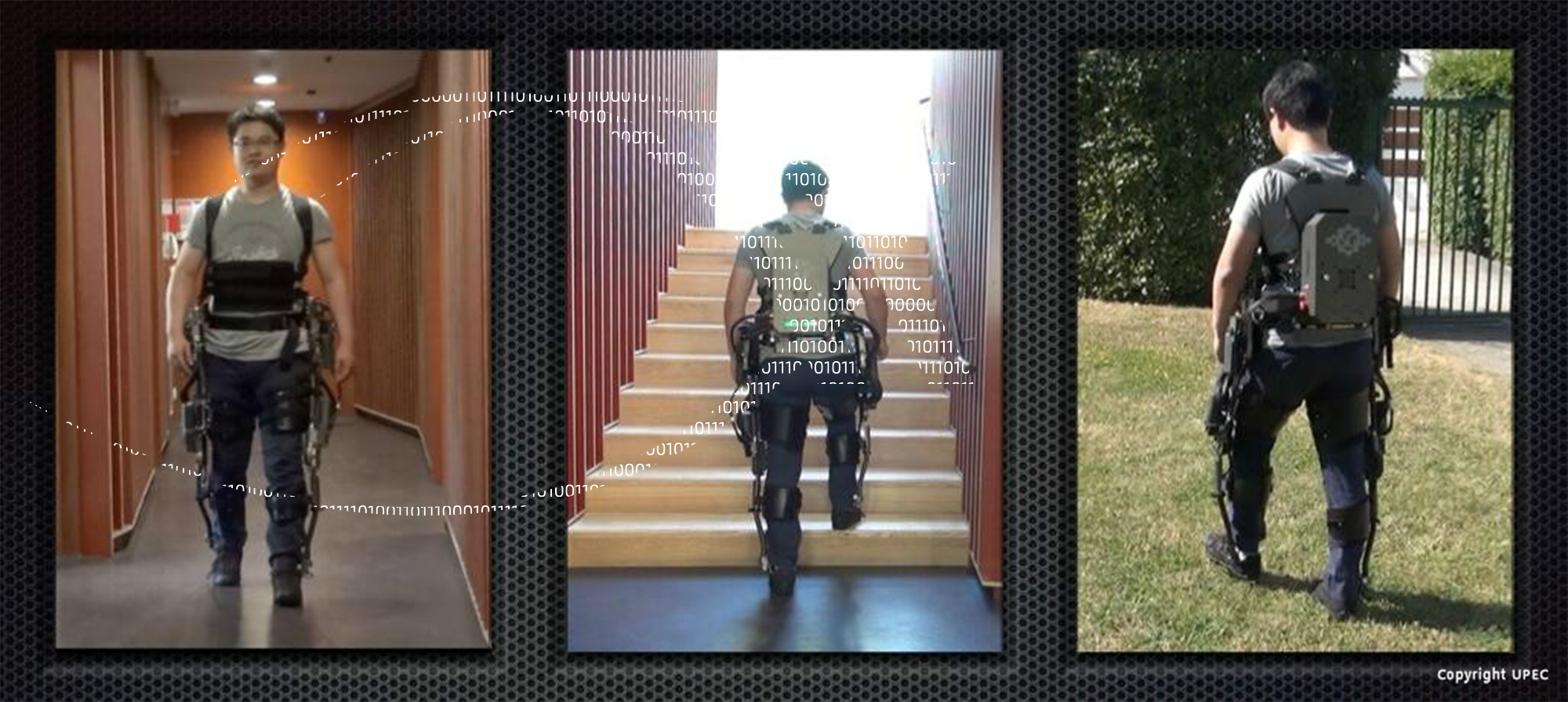

Human-Exoskeleton System Dynamics Identification Using Affordable Sensors
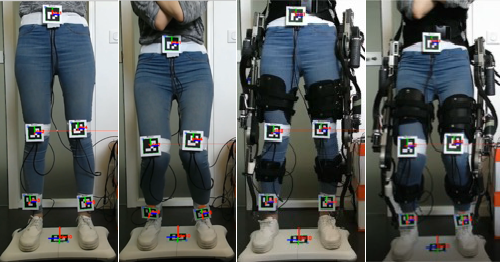
This demonstrator shows a practical method to identify body segments inertial parameters of a human-exoskeleton system using affordable and easy-to-use sensors. First, the joints and the base kinematics are estimated based on the use of an extended Kalman filter and QR visual markers. Then, joints kinematics are used in a dynamic identification pipeline together with the ground reaction force and moments collected with an affordable Wii Balance Board. The identification process is done using an augmented regressor matrix to identify at once each segment mass, center of mass 3D position and inertia tensor elements of both human locomotor apparatus and exoskeleton. The proposed method is able to accurately estimate external force and moments with less than 6% of normalized RMS error in average and is experimentally validated with a subject wearing a full lower-limb exoskeleton as it is shown in the below video.
References:
[1] R Mallat, V Bonnet, W Huo, P Karasinski, Y Amirat, M. Khalil and S Mohammed, “Human-Exoskeleton System Dynamics Identification Using Affordable Sensors", Proc. Of the IEEE International Conference on Robotics and Automation, ICRA 2018
[2] R. Mallat, V. Bonnet, M. Khalil, S. Mohammed, “Dynamic identification of a human-exoskeleton-system”, in Proc. Of the 4th IEEE International Conference on Advances in Biomedical Engineering, ICABME 2017, Beirut, Lebanon, 19-21 Oct. 2017, pp. 1-4.