
Smart-rules
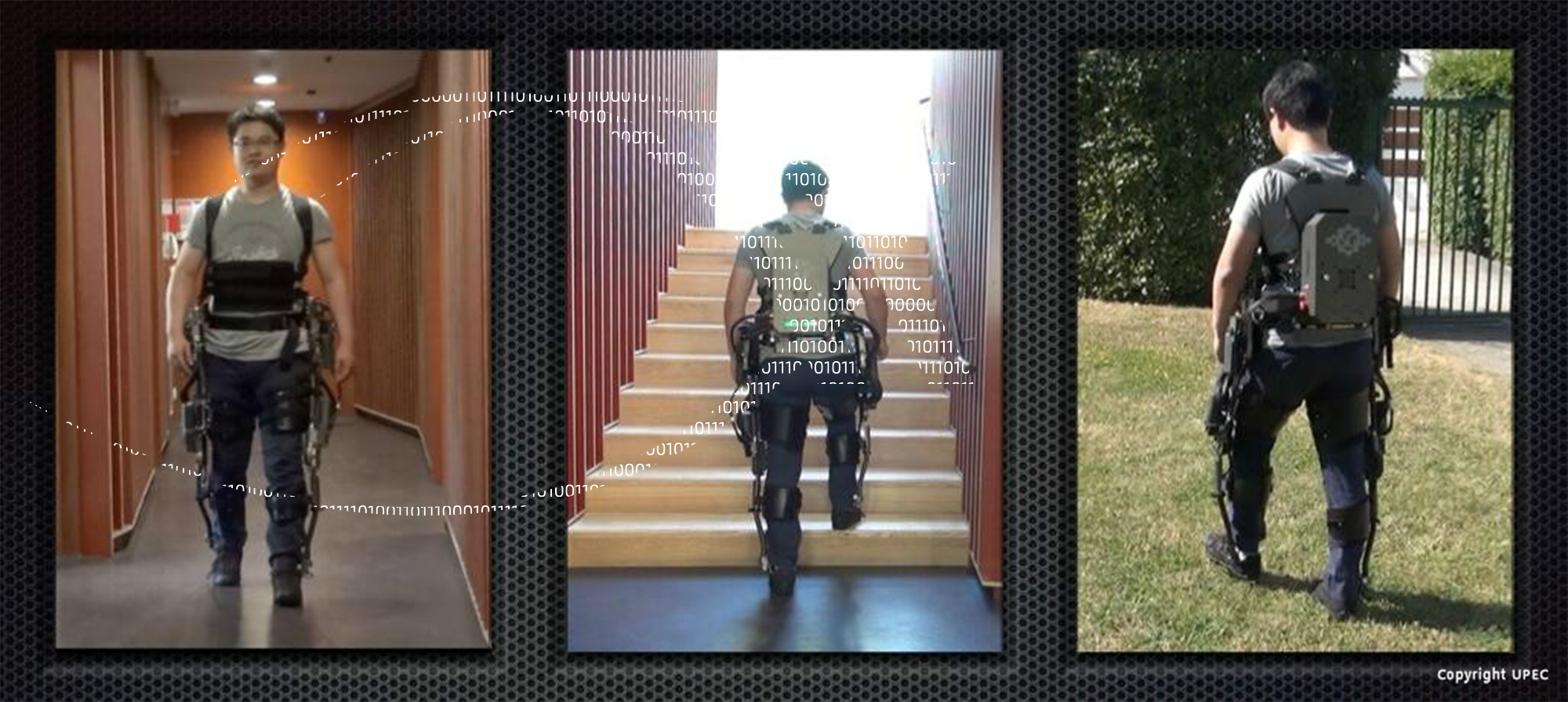
The Internet of Robotic Things (IoRT) is an emerging vision that brings together pervasive sensors and objects with robotic and autonomous systems. The Smart-rules framework, previously called SembySem, is the result of the research activities that were undertaken with some partners in the context of the European project SEMbySEM. The Smart-rules framework allows IoRT operators to easily setup and reuse context monitoring rules and handle different reactive strategies according to the captured contexts coping with different levels of perception of the real world. The context monitoring logic is based on a production rules language designed specifically for enabling the generation of actions when some contextual conditions hold. These conditions are semantically specified by using in a dedicated ontology language, called µ-Concept.
Smart-rules is particularly fitting for IoRT systems that need to perform reactive, online reasoning, as it uses unique name assumption and closed-world reasoning. It also includes a series of constructs that facilitate the handling of incomplete information due to failures in perception.
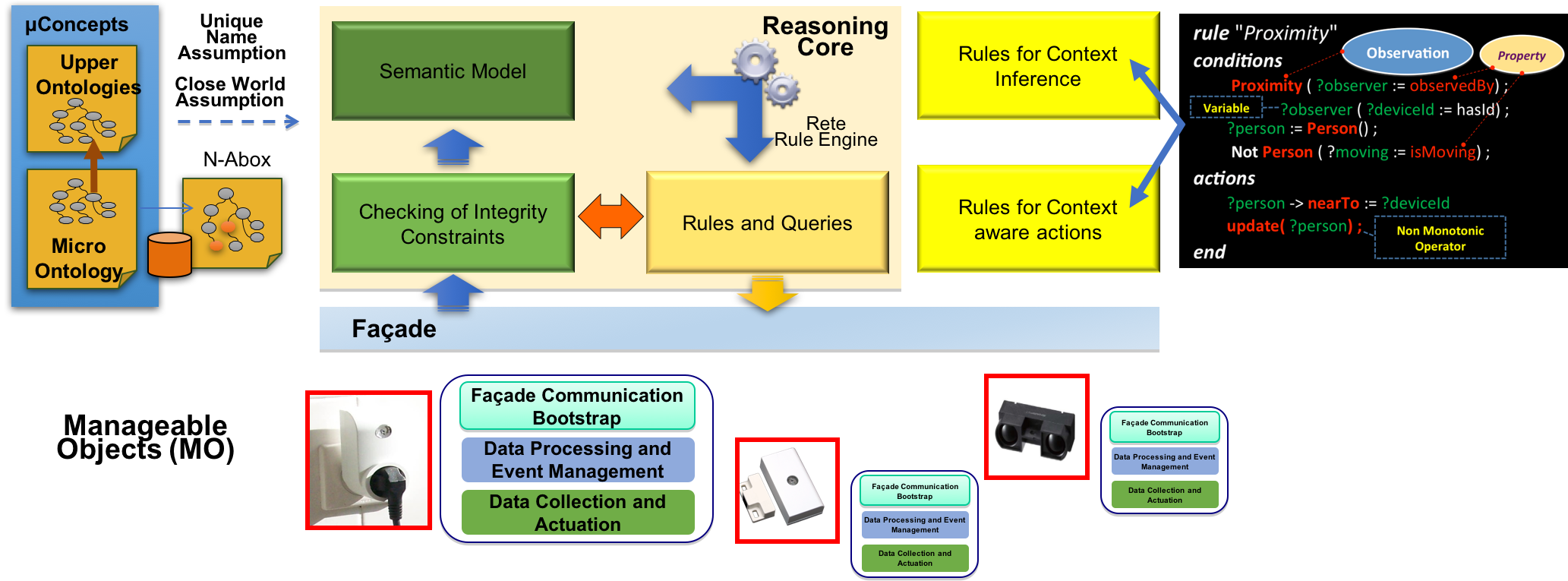
Smart-rules is also an operational platform that allows different IoRT operators to easily set up and handle different real-world heterogeneous entities, which are called manageable objects (MOs). An MO is any physical or virtual object that is manipulated by an IoT system. It includes sensors and actuators, as well as people, home objects, doors, robots and rooms. MOs are represented within the system by interfaces which abstract access to the MO’s state and operations. The architecture of the Smart-rules operational platform, illustrated in the figure above, is composed of two main layers: (1) the reasoning core layer that handles monitoring operations and reasoning, and (2) the façade layer for the interaction with the real-world sensing and actuation devices. The communication is based on java messaging middleware that enables some sorts of asynchronous communications between the two layers. The façade layer abstract the complexity and heterogeneity of the manageable objects. The reasoning core layer is a run-time reasoning system for managing the context logic independently from the complexity and heterogeneity of a IoRT environment.
References:
[1] L. Sabri, S. Bouznad, S. Fiorini, A. Chibani, E. Prestes, and Y. Amirat, "An integrated semantic framework for designing context-aware Internet of Robotic Things systems," Integrated Computer-Aided Engineering, IOS Press, vol. 25, no. 2, pp. 137-156, 2018.<hal-01699863>.
[2] S. Bouznad, A. Chibani, Y. Amirat, L. Sabri, E. Prestes, F. Sebbak, and S. Fiorini, "Context-Aware Monitoring Agents for Ambient Assisted Living Applications," in Proc. Of the 13th European Conference on Ambient Intelligence, AmI 2017, Malaga, Spain, 2017, pp. 225-240.<hal-01539387> .
[3] A. Chibani, A. Bikakis, T. Patkos, Y. Amirat, S. Bouznad, N. Ayari, and L. Sabri, "Using Cognitive Ubiquitous Robots for Assisting Dependent People in Smart Spaces," in Intelligent Assistive Robots- Recent advances in assistive robotics for everyday activities, S. Mohammed and J. C. Moreno and K. Kong and Y. Amirat Eds, Springer Tracts on Advanced Robotics (STAR) series, 2015, pp. 297-316. <hal-01540976> .
[4] L. Sabri, A. Chibani, Y. Amirat, G. P. Zarri, and P. Gatellier, "Semantic framework for context-aware monitoring of AAL ecosystems," in Ambient Assisted Living, N. M. Garcia and J. Rodrigues and D. C. Elias and M. S. Dias and Eds. Eds, Taylor and Francis / CRC Press, 2015, pp. 573-602.<hal-01540977>.