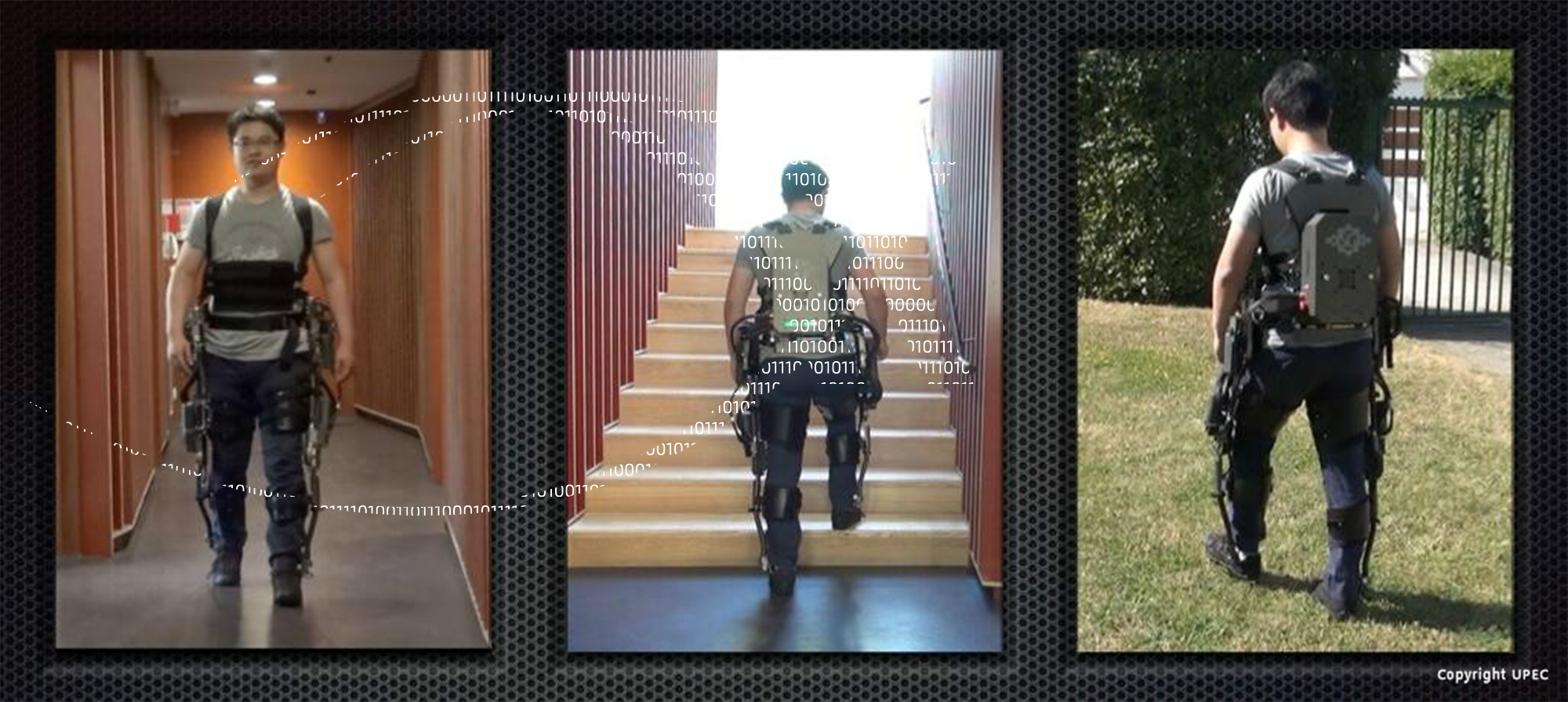


Thesis Defense of Randa Mallat
Randa Mallat, a PhD candidate from the SIRIUS team, will defend her thesis on January 28, 2021, in the RT Amphitheater at the Vitry-sur-Seine campus of UPEC—120 rue Paul Armangot, 94400 Vitry-sur-Seine.
Title: Toward an affordable multi-modal motion capture system framework for human kinematics and kinetics assessment
Abstract:
The quantification of human motor activities requires the measurement and estimation of kinematic and dynamic variables as accurately as possible. Human motion analysis has a wide range of applications in the fields of functional rehabilitation, orthopedics, sports, assistive robotics, and industrial ergonomics. Current motion analysis systems generally refer to stereophotogrammetric systems and laboratory force platforms, which are accurate but also expensive, requiring expert skills and are not portable. Recently, the use of low-cost sensors for estimating human motion, such as inertial measurement units and RGB cameras, has been the subject of numerous studies. Despite their great potential for use outside the laboratory, these systems still suffer from limited accuracy, primarily due to the inherent drift of inertial sensors and occlusions when using cameras, making precise estimation of joint kinematics and dynamics difficult to guarantee. These restrictions may explain why such systems are rarely used in clinical applications or for home rehabilitation. In this context, this thesis aims to develop a new low-cost motion analysis system enabling precise estimation of the 3D state of human joints. Unlike previous studies based solely on visual or inertial sensors, the proposed approach focuses on the combination of data from newly designed visual-inertial sensors. The system also utilizes practical calibration methods that require no external equipment. The sensor data is combined in a constrained extended Kalman filter that considers the biomechanics of the human body and the tasks performed to improve kinematic estimation. This is achieved by incorporating rigid body constraints, joint limits, and modeling the temporal evolution of joint trajectories or inertial sensor drift. The system's ability to estimate 3D joint kinematics was validated through the analysis of several daily arm activities as well as treadmill gait analysis. Two prototypes with different numbers and configurations of sensors were studied. Experiments conducted with several healthy subjects showed very satisfactory results compared to a reference stereophotogrammetric system. Overall, the root mean square error obtained was less than 4 degrees. This system was also used to identify the dynamic parameters of the lower limbs of a human-exoskeleton system. An evaluation system was proposed to select an optimal dynamic model of the human-exoskeleton system that provides the best compromise between the accuracy of the estimated joint torques and the model's simplicity. In this context, the proposed system aims to quantify the independent contribution of kinematic and dynamic parameters in estimating joint torque, as well as the effect of relative motion between the joint axes of the exoskeleton and the wearer. An evaluation was conducted on a knee assistive orthosis during flexion/extension movements. The results led to the proposal of a minimal model of the human-orthosis system.