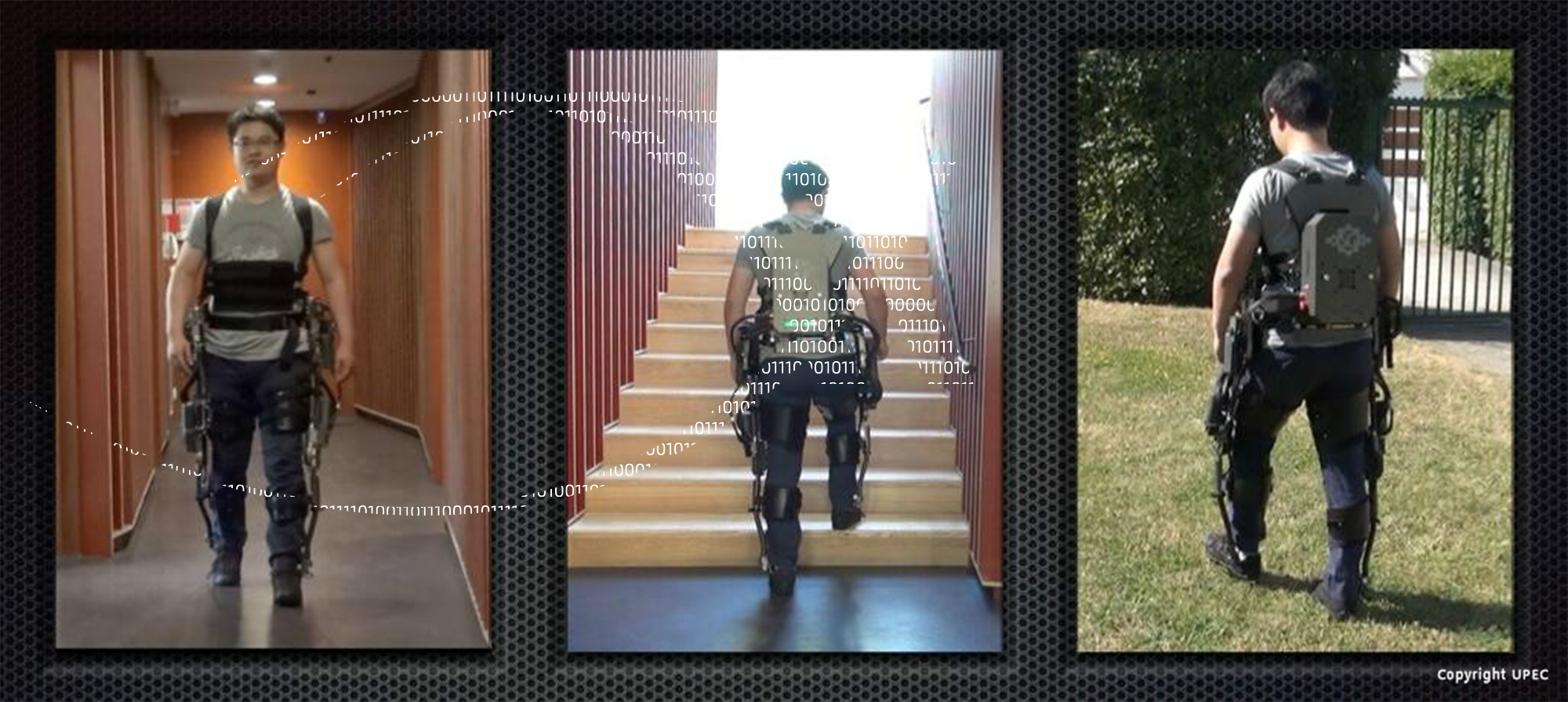
Exoskeleton Intelligently COmmunicating and Sensitive to Intention
The aging of the population in Europe is a crucial challenge of the 21st century. In most industrialized countries, the number of older people is rising steadily.
Assistance to these people has long been the subject of research aimed at developing equipment and support systems to improve their quality of life. The development of an exoskeleton prototype for the control of knee compliance is part of the research axis "network robotic services" and more specifically the theme "wearable robots" (wearable robots) of the team SCTIC of the LISSI laboratory.
The goal is to develop a portable robotic system to increase the independence of dependent people with insufficient knee compliance. This project is supported by the gerontechnology skills network of the Charles Foix Hospital Longevity Institute. The design of this exoskeleton is based on the study of kinematics and dynamics of the knee joint during the person's daily activities. This robotic system is designed to react according to the intention of the user by amplifying the force generated by the quadriceps muscle group, while ensuring sufficient compliance in different contexts (verticalization, walking, climbing stairs, etc.). This compliance is estimated based on measurement tools: goniometers, baropodometric insoles, EMG measurement electrodes, stress sensors, etc. Being a portable robotic system designed to provide functional assistance to a dependent person and to meet the criteria of portability, comfort and adaptability, the design of the prototype is constrained to the deployment of compact interaction technologies, miniaturized and energetically efficient.
The purpose of the proposed system in addition to the elements mentioned above, is to allow better control of knee compliance. Preliminary results have shown that imposing a desired overall compliance of the knee-muscle system induces motor torque at the knee joint. As regards the control strategy, it is a question of studying and implementing robust control algorithms whose complexity depends on the task to be performed. From an integration point of view, the objective will be to take into account contextual knowledge related to the user (intention, posture, localization) through a Semantic Middleware dedicated to the provision and composition of context-sensitive services in ambient intelligent systems integrating ubiquitous robots. This platform is developed at LISSI as part of the European project ITEA SEMBYSEM (2008-2011).